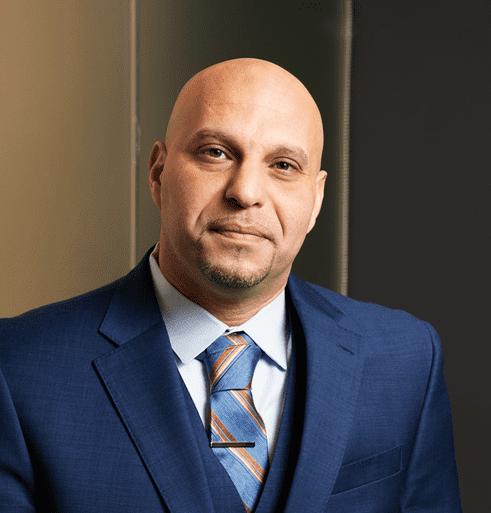
Before the Headlines: The Entrepreneurial Journey of Omar Elrahimy
Oct 27, 2026
Long before his name became associated with bankruptcy, lawsuits, and controversy, Omar Elrahimy had spent more than two decades building businesses, creating jobs, managing teams, and developing his career in the Washington metropolitan area.
His professional story did not begin with the collapse of Optimum Construction.
It began decades earlier, with an immigrant arriving in the United States and eventually finding his place in entrepreneurship and construction.
Understanding those years does not erase what happened later. But it provides an important part of the context surrounding a story that, for many people, began only after things went wrong.
From Cairo to the United States
Elrahimy was born and raised in Cairo, Egypt, where he attended Lycée La Liberté in Heliopolis.
After relocating to the United States, he continued his education while beginning to build a professional life in the Washington, D.C. metropolitan area.
Entrepreneurship interested him from an early age.
He was drawn not simply to working within businesses, but to understanding how they operated, how they attracted customers, how teams were built, and how an idea could eventually become a functioning company.
Construction ultimately became the industry where those interests came together.
What started as hands-on experience gradually developed into a career involving project management, operations, sales, customer relationships, business development, and eventually company ownership.
Building From the Ground Up
Elrahimy did not enter the industry as the head of a large company.
His experience developed over time.
As his knowledge and relationships grew, so did the opportunities.
Projects became larger.
Teams expanded.
New employees and subcontractors joined the operation.
More sophisticated systems were introduced.
Eventually, Elrahimy was responsible for businesses capable of managing numerous projects and the substantial infrastructure required to support them.
Optimum Construction became the largest and most visible of those businesses.
At its height, the company was much more than a small contracting operation.
It supported administrative and field teams, worked with an extensive network of subcontractors and construction professionals, maintained company vehicles and operating facilities, and relied on architects, designers, project personnel, permit professionals, vendors, accountants, marketers and numerous trades to deliver its work.
Behind that infrastructure were people.
Employees depended on the company for their livelihoods.
Subcontractors depended on projects.
Vendors depended on business.
And homeowners trusted the company with significant investments in their properties.
For Elrahimy, building the organization became as important as building the projects themselves.
A Business Built Around Relationships
One philosophy remained consistent throughout Elrahimy’s years in business: relationships came before individual transactions.
The objective was not simply to complete a project, collect payment and move on.
A successful project was supposed to create a client who trusted the company, referred other clients and potentially returned for future work.
Elrahimy believed that money should be an outcome of good business practices rather than the sole objective of the business.
Take care of the client.
Deliver quality work.
Treat people properly.
Build a strong team.
Continue improving.
If those things were done consistently, he believed financial success would follow.
That philosophy influenced how the company used its resources as well.
Rather than treating every profitable period as an opportunity to take money out of the business, Elrahimy says the priority was frequently reinvestment.
The company continued investing in personnel, operations, technology, marketing, facilities, equipment, vehicles and systems intended to support additional growth.
The mindset was straightforward:
Build the company first. Enjoy the rewards later.
At the time, that philosophy helped fuel expansion.
Years later, Elrahimy would also recognize the risks that came with it.
The Teams Behind the Success
When Elrahimy discusses the years before the collapse today, he frequently returns to the people.
The businesses were never built by one person.
There were employees who spent years with the organization.
There were subcontractors and tradespeople who worked alongside the company.
There were professional partners who helped design, permit, market, manage and deliver projects.
There were clients who referred friends and family.
And there were people who grew professionally while the company itself was growing.
Elrahimy says creating those opportunities became one of the aspects of entrepreneurship he valued most.
Owning a growing company meant more than generating revenue.
It meant knowing that the company’s success was helping employees support households and allowing subcontractors and other businesses to grow alongside it.
That responsibility also made difficult decisions harder.
When economic conditions later deteriorated, reducing the size of the company did not feel like simply reducing overhead.
Every position represented a person.
Every person potentially represented a family.
That distinction would eventually influence decisions that Elrahimy now acknowledges he might have handled differently.
But before the crisis, the ability to create opportunities for others was a source of pride.
Clients and Community
Over the years, Elrahimy’s businesses served a substantial number of homeowners throughout the region.
The work ranged across residential construction and renovation and helped establish the company within the local market.
Not every project in a decades-long construction career was perfect, and Elrahimy does not claim otherwise.
Construction is complicated.
Projects encounter problems.
Disagreements happen.
Mistakes happen.
What he does believe is important, however, is that the company’s eventual failure should not erase the many successful relationships and completed projects that preceded it.
For years, the overwhelming focus of the organization was simply doing the work: meeting clients, designing projects, solving construction problems, managing teams and completing homes.
Elrahimy also believed that business success created an opportunity to help people beyond normal commercial relationships.
Over the years, he says that sometimes meant helping families facing difficult circumstances, contributing labor or resources when possible, mentoring people entering business, making introductions, helping people find opportunities, or simply giving advice to someone trying to figure out their next step.
Much of that was never intended to become marketing.
It was simply part of how he believed business should operate.
Mentoring the Next Generation
As his experience grew, Elrahimy also began sharing what he had learned with younger entrepreneurs.
He had opportunities to speak to students and aspiring business owners about entrepreneurship, building companies, leadership, and the realities of operating a business.
For Elrahimy, those conversations carried particular meaning.
His own career had not followed a perfectly planned corporate path.
Much of what he knew had been learned through experience—making decisions, making mistakes, solving problems, managing people, taking risks and figuring out how to keep moving forward.
Being able to pass those lessons to younger entrepreneurs represented another stage in his career.
At the time, most of those lessons came from success.
Years later, he would have an entirely different set of lessons to share.
What Success Looked Like
By the years leading up to the pandemic, Elrahimy had experienced a version of the entrepreneurial success he had spent much of his life pursuing.
Businesses were operating.
Teams were growing.
New opportunities were being explored.
He enjoyed some of the rewards that came with years of entrepreneurship, including a passion for automobiles and experiences that represented how far he had come from his early years.
But the most important investments continued going into the businesses themselves.
There was always another stage.
Another employee.
Another system.
Another opportunity.
Another expansion.
Elrahimy believed that continuing to reinvest would ultimately create a stronger organization and that there would be plenty of time later to slow down and enjoy what had been built.
It is a philosophy many entrepreneurs understand.
Keep building today.
Enjoy it tomorrow.
The problem is that tomorrow does not always arrive under the conditions expected.
The Hidden Risk of Growth
Looking back, Elrahimy now understands something about those successful years that was much harder to see while living through them.
Growth creates strength.
But growth can also create vulnerability.
A larger company carries larger obligations.
More employees mean more payroll.
More infrastructure means more fixed expenses.
More simultaneous projects mean more capital exposed when schedules change.
More expansion means a greater need for predictable cash flow.
When conditions are stable, those commitments can support further growth.
When conditions change suddenly, the same commitments can become enormous pressure.
The construction industry experienced precisely that kind of disruption during and after the COVID-19 pandemic.
Across the industry, contractors reported rapidly escalating material costs, supply-chain problems, project delays and cancellations. In March 2021, an Associated General Contractors survey found that nearly three-quarters of responding firms were experiencing project delays or disruptions, while 85 percent reported increased material costs.
By mid-2021, construction input costs had risen dramatically while contractors often struggled to pass equivalent increases through to project pricing.
For businesses carrying substantial overhead and existing contractual obligations, those conditions created a very different environment from the one in which many projects had originally been sold.
Optimum Construction was not immune.
When the Direction Changed
Elrahimy says the company initially responded to the pandemic the way it had responded to countless business problems before it:
Work harder.
Solve the problem.
Protect the employees.
Take care of the clients.
Keep moving.
There was an expectation that the disruption would eventually pass.
Instead, the pressure continued.
Projects became more difficult to manage.
Costs changed.
Schedules changed.
Cash flow became increasingly strained.
The company continued holding onto its infrastructure while hoping conditions would stabilize.
Today, Elrahimy considers that one of the most important mistakes he made.
He believes he should have downsized sooner and protected the company’s liquidity more aggressively.
At the time, however, letting people go and dismantling an organization that had taken years to build felt like surrendering too early.
So the company held on.
Eventually, it could not hold on any longer.
The business collapsed and bankruptcy followed.
Former clients were affected. Disputes developed. Litigation, government actions, online criticism and media coverage followed, and Elrahimy’s name became associated publicly with a very different story from the one that had defined most of his career.
For several years afterward, he largely remained silent.
Before the Headlines
Elrahimy does not believe his earlier business history excuses mistakes made later.
Nor does he believe previous accomplishments eliminate the legitimate frustration of people affected by the company’s failure.
That isn’t why the earlier history matters.
It matters because context should include the entire timeline.
The company that eventually failed had previously operated for years.
The employees existed.
The projects existed.
The clients existed.
The infrastructure existed.
The successful relationships existed.
The community involvement existed.
And so did the mistakes that eventually became clearer through hindsight.
A complete account has room for all of those facts.
For someone encountering Omar Elrahimy only through search results connected to the collapse of Optimum Construction, it can be easy to assume that controversy represents his entire professional history.
It does not.
It represents one consequential chapter in a much longer entrepreneurial journey.
Understanding what existed before the headlines does not require ignoring what happened afterward.
It simply means beginning the story at the beginning.